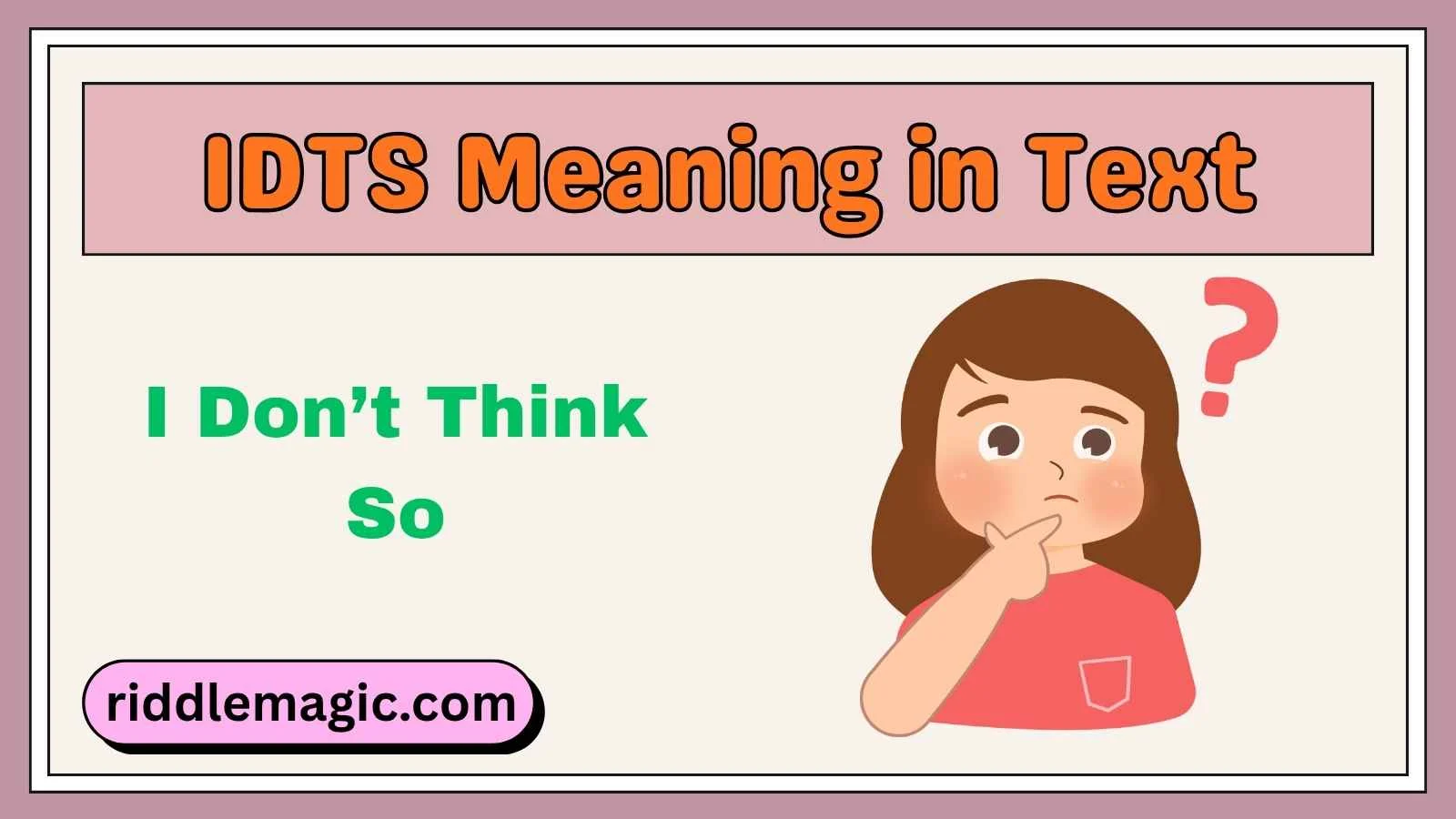
In today’s fast-moving digital world, texting shortcuts and slang have become a huge part of everyday communication. One of the most commonly used expressions you might see in chats, social media, or online conversations is “IDTS meaning in text”.
If you’ve ever come across “IDTS” and felt confused, you’re not alone. This abbreviation is widely used, but its meaning can sometimes feel unclear depending on context.
Simply put, IDTS stands for “I Don’t Think So”. It is used when someone wants to politely or casually disagree with something, show doubt, or respond negatively without sounding too harsh.
In this complete guide, we will break down everything about IDTS meaning in text, including its origin, usage, examples, variations, tone, and real-life chat scenarios. 🚀
By the end of this article, you’ll not only understand the IDTS meaning in text, but you’ll also know exactly how to use it naturally like a pro in conversations.
📌 What Does IDTS Mean in Text?
The abbreviation IDTS meaning in text is very simple once you decode it. It stands for:
- I – I
- D – Don’t
- T – Think
- S – So
So, IDTS = I Don’t Think So 😄
It is mostly used in informal conversations like texting, chatting on apps, gaming chats, and social media comments. The tone is usually casual, slightly uncertain, or politely disagreeing.
💡 Example: “Are you going to the party tonight?” Reply: “IDTS, I’m kinda busy.”
📖 Origin of IDTS Slang
The IDTS meaning in text comes from early internet chat culture in the late 1990s and early 2000s. During that time, people wanted faster ways to type messages on keyboards and mobile phones. As texting became more popular, abbreviations like LOL, BRB, and IDTS emerged.
Unlike formal English, internet slang evolved to make conversations quicker and more expressive. IDTS became popular in SMS messaging and later spread to platforms like Facebook, WhatsApp, Instagram, and Discord.
Even today, the IDTS meaning in text remains widely used because it’s short, simple, and conveys polite disagreement without sounding rude.
🧠 Why People Use IDTS in Conversations
There are several reasons why people prefer using IDTS meaning in text instead of writing full sentences:
- ⚡ Saves time while typing
- 💬 Makes conversations more casual
- 🙂 Softens disagreement
- 📱 Perfect for mobile texting
- 🧠 Common internet culture habit
Instead of saying “I don’t think so,” which feels long and formal, people simply type IDTS to keep things short and natural.
💬 IDTS Meaning in Different Contexts
The interesting thing about IDTS meaning in text is that it can change slightly depending on context. Let’s break it down:
| Context | Meaning | Example |
|---|---|---|
| Casual chat | Polite disagreement | IDTS, maybe later |
| Uncertainty | Not sure | IDTS that will work |
| Opinion response | Soft “no” | IDTS, I prefer the other option |
As you can see, the IDTS meaning in text is flexible and adapts based on tone and situation.
🔥 Real-Life Examples of IDTS in Texting
Let’s look at some real-world chat examples to fully understand IDTS meaning in text:
- Friend 1: “Are you coming to school tomorrow?” Friend 2: “IDTS, I’m not feeling well.”
- Friend 1: “Do you think he likes her?” Friend 2: “IDTS, he seems confused.”
- Friend 1: “Will it rain today?” Friend 2: “IDTS, weather looks clear.”
These examples show how naturally the abbreviation fits into everyday communication.
😎 Tone of IDTS: Is It Rude or Polite?
One of the most important aspects of IDTS meaning in text is tone. Luckily, IDTS is usually:
- ✔️ Neutral
- ✔️ Slightly informal
- ✔️ Politely negative
It is not considered rude. Instead, it softens disagreement. For example:
❌ “No, I don’t think so.” (direct) ✔️ “IDTS.” (soft and casual)
That’s why IDTS is widely used in friendly conversations rather than professional or formal communication.
📱 Where Is IDTS Commonly Used?
The IDTS meaning in text is most popular in digital communication platforms such as:
- 📲 WhatsApp chats
- 📸 Instagram DMs
- 💬 Facebook Messenger
- 🎮 Gaming chats
- 📱 Snapchat conversations
It is rarely used in formal emails, business communication, or academic writing.
🆚 IDTS vs Other Similar Slang
To better understand IDTS meaning in text, let’s compare it with similar expressions:
| Slang | Full Form | Meaning |
|---|---|---|
| IDTS | I Don’t Think So | Polite disagreement |
| NOPE | No | Direct negative response |
| NAH | No | Casual refusal |
| IMO | In My Opinion | Personal viewpoint |
Among these, IDTS stands out because it sounds more thoughtful and less harsh.
🧩 Variations of IDTS You Might See
Sometimes, people modify the IDTS meaning in text slightly for expression:
- idts – lowercase casual form
- IDT so – shortened variation
- idk tbh – similar uncertain tone (not exact synonym)
These variations still reflect doubt or disagreement in conversation.
📊 Psychological Impact of Using IDTS
Interestingly, the IDTS meaning in text is not just linguistic—it also has psychological effects in communication:
- 🧠 Reduces conflict in conversations
- 💬 Makes responses feel softer
- 🙂 Maintains friendly tone
- ⚖️ Balances disagreement and politeness
That’s why people prefer IDTS over a blunt “No.”
🚫 Common Mistakes When Using IDTS
Even though IDTS meaning in text is simple, people sometimes misuse it:
- ❌ Using it in formal emails
- ❌ Overusing it in serious conversations
- ❌ Misunderstanding tone in professional settings
Always remember: IDTS is for casual communication only.
🌍 IDTS in Global Internet Culture
The IDTS meaning in text is not limited to one country. It is widely recognized in global internet culture, especially among English-speaking users. With the rise of social media, slang like IDTS has become universal.
From teenagers to adults, people use it to make communication faster and easier.
📌 Summary Table of IDTS Meaning
| Aspect | Details |
|---|---|
| Full Form | I Don’t Think So |
| Type | Internet Slang |
| Tone | Casual / Polite |
| Usage | Chats, social media, texting |
❓ FAQs:
1. What does IDTS mean in chat?
IDTS means I Don’t Think So and is used to politely disagree or show doubt.
2. Is IDTS rude?
No, IDTS is not rude. It is a soft and casual way to say “no” or express uncertainty.
3. Where is IDTS commonly used?
It is commonly used in texting apps, social media platforms, and online chats.
4. Can I use IDTS in formal writing?
No, IDTS is informal and should not be used in professional or academic writing.
5. What is the full form of IDTS?
The full form is I Don’t Think So.
🏁 Conclusion: Final Thoughts on IDTS Meaning in Text
To sum it up, the IDTS meaning in text is a simple yet powerful slang expression that stands for “I Don’t Think So.” It is widely used in casual conversations to express disagreement or doubt in a soft and friendly way.
From chatting with friends to commenting online, IDTS helps keep communication short, smooth, and natural. However, it should always be used in informal contexts only.
Understanding slang like IDTS not only improves your digital communication skills but also helps you stay connected with modern internet culture. 🌐

I’m John Alex, a word enthusiast and meaning explorer behind a platform dedicated to uncovering the stories, slang, phrases, and hidden meanings behind everyday words. I love turning confusing terms into simple, engaging explanations that readers can instantly connect with. My goal is to make language fun, clear, and easy to understand while helping people stay updated with trending meanings and modern expressions across the internet.